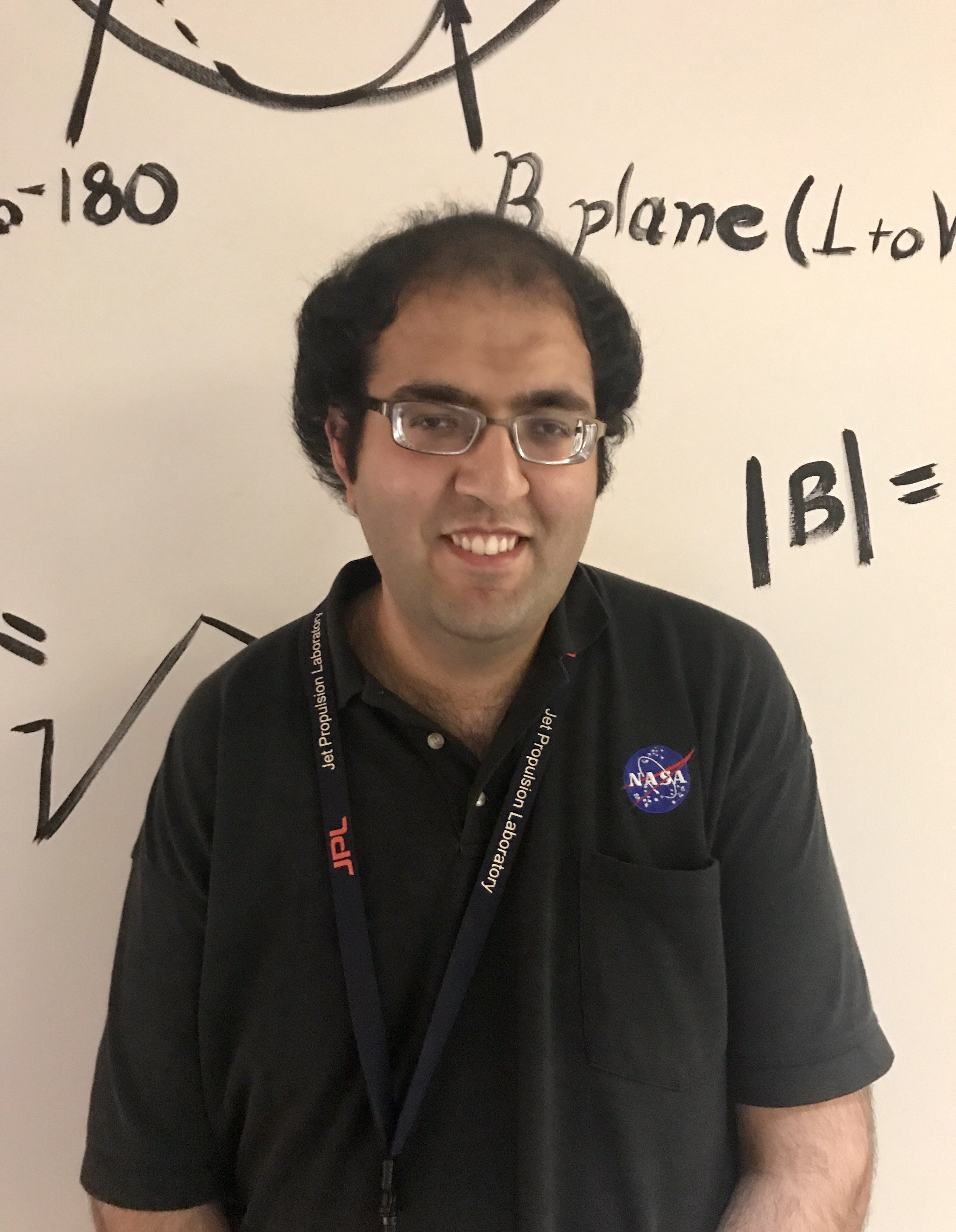
Mission Analysis Section,
Flight Dynamics Division (OPS-GFA)
European Space Operations Centre
ESA - European Space Agency
64293 Darmstadt, Germany
Email: Firstname.Lastname (at) ext.esa.int
Curriculum Vitae
(updated 18 Oct 2026)
I am currently a mission analysis engineer at the European Space Agency's European Space Operations Centre (ESA-ESOC) contributing to trajectory planning, design, and analysis for ESA's lunar and interplanetary missions.
I hold a Ph.D. in mathematics from Georgia Tech, advised by Prof. Rafael de la Llave, in the field of Hamiltonian dynamical systems and multi-body orbital mechanics, as well as MS and BS degrees in aerospace engineering (plus a BS in applied math) from the same.
Prior to joining ESOC in June 2026, I conducted postdoctoral research stays at the NASA Jet Propulsion Laboratory, the University of Michigan (where I also served as an instructor for various courses), and Universität Heidelberg in Germany.
I also conducted numerous internships and visiting research stays at JPL during my Ph.D., working in the Mission Design and Navigation section there with Dr. Rodney Anderson.
Research Interests
In addition to my current work on ESA's science and exploration missions, I also continue a number of lines of research that I have been involved in for many years.
At a broad level, my interests lie in the application of tools and results from mathematical dynamical systems theory and symplectic geometry, both analytical and computational, to problems in celestial mechanics and applied astrodynamics for space mission design.
In particular, there are geometric structures, such as periodic orbits, invariant tori, and stable and unstable manifolds, which govern many of the important dynamical properties of multi-body celestial systems.
I am interested in developing fast and accurate methods for computing these objects as well as for investigating the dynamics induced by them.
I am particularly interested in studying how resonant phenomena - both chaotic and stable - occur and can be leveraged profitably in various planet-moon systems, especially those of the outer planets as well as our own Earth-Moon region.
Selected Journal and Conference Papers
- The Effect of Untargeted Moons on Resonant Orbit Structure Between Titan and Rhea
Proceedings of the 2026 AAS/AIAA Astrodynamics Specialist Conference,
Paper Link
- Resonances, Invariant Manifolds, and Low-Thrust Lunar Transfers: the Case of ESA’s SMART-1
(with R. Anderson)
Proceedings of the 30th International Symposium on Space Flight Dynamics,
Paper Link
- Lunar Exterior Mean-Motion Resonances
(with A. Rawat, A.J. Rosengren, and S.D. Ross)
Proceedings of the 30th International Symposium on Space Flight Dynamics,
Paper Link
- Multi-shooting parameterization methods for invariant manifolds and heteroclinics of 2 DOF Hamiltonian Poincaré maps, with applications to celestial resonant dynamics
Journal of Nonlinear Science, Paper Link,
Preprint Link
- A new fast multiple-shooting method for computing periodic orbits in symplectic maps leveraging simultaneous Floquet vector computation to avoid large linear systems
Preprint Link
- Cislunar Resonant Transport and Heteroclinic Pathways: From 3:1 to 2:1 to L1
(with A. Rawat, A.J. Rosengren, and S.D. Ross)
Advances in Space Research, Paper Link,
Preprint Link
- Networks of Periodic Orbits in the Earth–Moon System Through a Regularized and Symplectic Lens
(with A. Moreno)
Proceedings of the 2025 AAS/AIAA Astrodynamics Specialist Conference,
Paper Link
- Regions of Influence of Exterior Mean-Motion Resonances in the Earth–Moon System: Bifurcations, Separatrices, and Heteroclinic Pathways
(with A. Rawat, A.J. Rosengren, and S.D. Ross)
Proceedings of the 2025 AAS/AIAA Astrodynamics Specialist Conference,
Paper Link
- Cislunar Mean-Motion Resonances: Definitions, Widths, and Comparisons with Resonant Satellites
(with A. Rawat, A.J. Rosengren, and S.D. Ross)
Journal of Guidance, Control, and Dynamics, Paper Link,
Preprint Link
- Rapid GPU-Assisted Search and Parameterization-Based Refinement and Continuation of Connections between Tori in Periodically Perturbed Planar Circular Restricted 3-Body Problems
(with R. Anderson and R. de la Llave)
SIAM Journal on Applied Dynamical Systems, Paper Link, Preprint Link
- A Survey of Oberon Mean Motion Resonant Unstable Orbit Properties and Connections for Uranian Tours
(with R. Anderson)
Proceedings of the 2024 AAS/AIAA Astrodynamics Specialist Conference,
Paper Link
- 4th Body-Induced Secondary Resonance Overlapping Inside Unstable Resonant Orbit Families: a Jupiter-Ganymede 4:3 + Europa Case Study
(with R. Anderson and R. de la Llave)
Proceedings of the 2023 AAS/AIAA Astrodynamics Specialist Conference,
Paper Link
- Transfers between Jupiter-Ganymede and Jupiter-Europa Resonant Tori In a Concentric Circular Restricted 4-Body Model
(with R. Anderson and R. de la Llave)
Acta Astronautica, Paper Link
- Computation and Analysis of Jupiter-Europa and Jupiter-Ganymede Resonant Orbits in the Planar Concentric Circular Restricted 4-Body Problem
(with R. Anderson, R. de la Llave, and B. Gunter)
Proceedings of the 2021 AAS/AIAA Astrodynamics Specialist Conference,
Paper Link
- Rapid and Accurate Methods for Computing Whiskered Tori and their Manifolds in Periodically Perturbed Planar Circular Restricted 3-Body Problems
(with R. Anderson and R. de la Llave)
Celestial Mechanics and Dynamical Astronomy, Paper Link,
Preprint Link
- High-order resonant orbit manifold expansions for mission design in the planar circular restricted 3-body problem
(with R. Anderson and R. de la Llave)
Communications in Nonlinear Science and Numerical Simulation, Paper Link,
Preprint Link